Mangan Press/Catalogue/A Short History of Weather
Essays · Autumn 2026
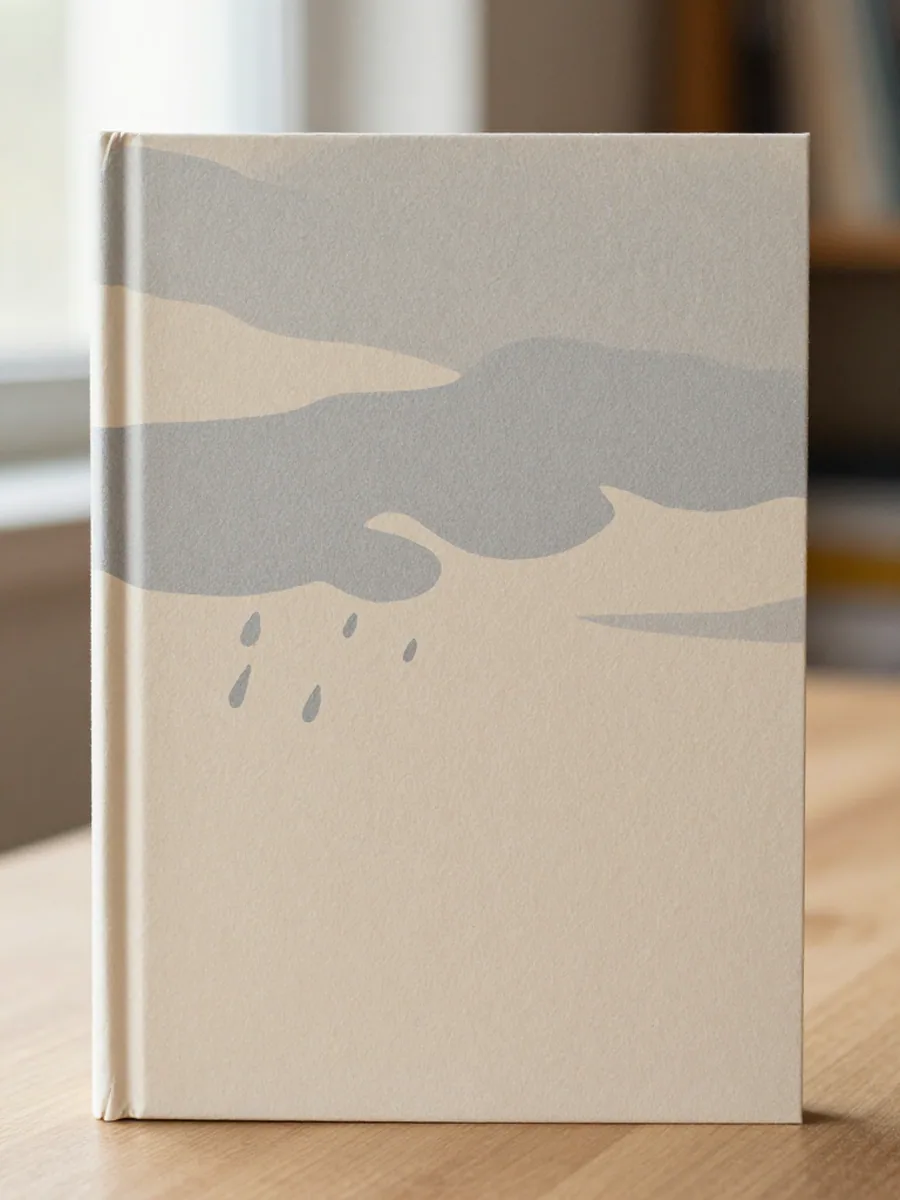
A Short History of Weather
Nine essays on forecasting, farming, grief and the English habit of talking about the sky.
£15.00 · 248 pages · published 8 October 2026 · 978-1-9999999-5-8
Ordered direct, the book is posted within two working days from the room where it was sewn. Write to us, or find a stockist. Ordering on this demonstration site is not connected to a payment system.
Tobias Renn grew up in a house where the shipping forecast was played at full volume at ten to one every night, in a valley where nobody owned a boat. These nine essays begin with that oddity and follow it outward: into the history of the barometer, the economics of hay, the peculiar language of the Met Office, and the year his father stopped going outside.
Renn is a patient, funny, slightly obsessive guide. He spends eleven pages on the word 'changeable' and makes every one of them earn its place. He goes to a rainfall station in Cumbria that has been read by hand, twice daily, by four generations of the same family, and comes back with something closer to a ghost story than a report.
The book's argument, if it has one, is that weather is the last subject we are all still allowed to be wrong about in public, and that this makes it the truest form of small talk we have left. But the argument is never pressed. Renn would rather show you a chart from 1878 and let you sit with it.
Written over six years and revised, the author says, mostly in car parks, A Short History of Weather is essay writing of the old, generous kind: curious, unhurried, and quietly heartbroken in the last thirty pages.
The barometer in the hall was a wedding present and a liar. It had been screwed to the wall in 1961 and never once adjusted for altitude, so it read a steady thirty millibars low, which meant that for sixty years my family lived in a permanent state of forecast anxiety about a storm that was, in the ordinary run of things, four counties away.
My father tapped it every morning on his way past. He knew it was wrong. He knew, moreover, that the tapping did nothing but jog a needle already settled. I have thought about that tap a great deal since, and I have decided it was not superstition. It was correspondence. He was writing to the sky, and the sky, being a barometer, was answering in a hand he had long ago learned to discount.
- Format
- Sewn hardback, 216 × 138 mm
- Extent
- 248 pages
- Paper
- Arctic Munken Cream 90 gsm
- Binding
- Section-sewn, oatmeal cloth over boards, claret head and tail bands
- Typeface
- Adobe Caslon, 11 / 15 pt
- Illustration
- Twelve line diagrams by the author
- Edition
- 1,500 copies
- ISBN
- 978-1-9999999-5-8
Elsewhere on the list
The full catalogueThe Salt Line
A woman returns to the estuary where her brother drowned, and finds the water has moved.
Novella · Autumn 2026 · 94 pages
£14.00September 2026978-1-9999999-4-1Bellringer
A first collection about sound, inheritance, and the churches of a childhood spent between two countries.
Poetry · Autumn 2026 · 78 pages
£12.00November 2026978-1-9999999-6-5Nightschool
Hal Everline
Eleven stories set in the lit rooms of a further education college between eight and ten at night.
Short fiction · Spring 2026 · 204 pages
£14.00March 2026978-1-9999999-1-0